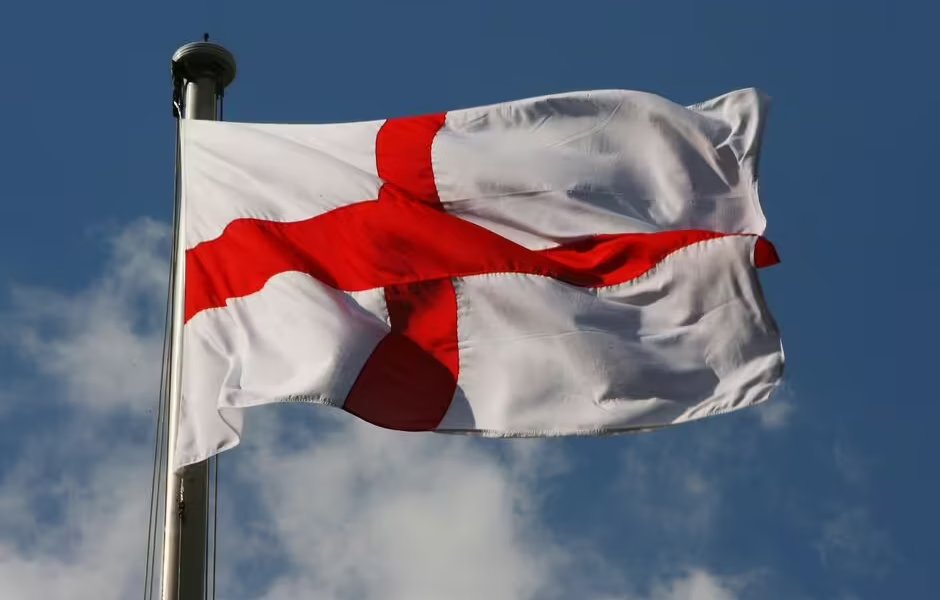


The flag of St George could land you a £2,500 fine and £250 a day (Image: Getty)
St George’s Day is officially here and up and down the country, English men and women will be celebrating St George, the patron saint of England and flying the St George’s Cross.
In recent years, the government has encouraged more people to fly flags on their homes, and most of the time, this is fine to do. But there are some occassions and situations in which flying a flag on your house could break planning regulations and be liable to a fine, or there may be times putting a flag on your car could be against the Highway Code.
Furthermore, the recent wave of attaching flags to lampposts and public spaces brings its own potential legal issues.
So if you’re planning on flying an England flag for the big day, you should be aware of all the rules governing the flying of flags in England.
The Government says in recent years it has relaxed the rules on flying flags, not just the Union Jack, but also the flags of England (the St George’s Cross), Wales, Ireland and indeed any national flag at all, as it wants to see more flags flown in general.
The rules for flying a flag on a roof are very open. The Government says certain flags can be flown from rooftops of any size, provided they meet certain conditions.
England flags – as well as Scottish flags, Commonwealth country flags, NHS and LGBT flags are all permitted to be flown from your house. These can be any size if they are flown from the roof, and will attract no fines as a result.
However, if you’re flying the flag on a flagpole ‘projecting from any part of the building other than the roof’, then in that situation, the flag cannot be larger than two metres squared in size.
Consent is also required if you live in a controlled area, such as an Area of Outstanding Natural Beauty (AONB).
Those who fail to comply with those rules could be reported and, ultimately, fined up to £2,500 for refusing to obey a request from your local council to remove an oversized flag.
One way to get around this is to fly the flagpole from the roof instead. Under the law, flags on a vertical flagpole flown from the roof have no maximum size, unless you’re in an AONB.
The Government sets out: “Two flags on the same flagpole projecting from any part of a building are permitted provided one of the flags is from category (a) (flags which do not need consent), such as a national flag, and that flag is flown in the superior position.
“Otherwise, only one flag on a projecting flagpole on a building is permitted.
“The flag may not exceed 2 square metres in size.”
The Government’s rules on flags say: “All flags must be:
- maintained in a condition that does not impair the overall visual appearance of the site
- kept in a safe condition
- have the permission of the owner of the site on which they are displayed (this includes the Highway Authority if the sign is to be placed on highway land)
- not obscure, or hinder the interpretation of official road, rail, waterway or aircraft signs, or otherwise make hazardous the use of these types of transport
- be removed carefully where so required by the planning authority

The St George’s Cross is legal to fly but must be done within planning rules (Image: Getty)
Fines for flying flags which break rules
The full list of flags that do not require consent are:
- Any country’s national flag, civil ensign or civil air ensign
- The flag of the Commonwealth, the United Nations or any other international organisation of which the United Kingdom is a member
- A flag of any island, county, district, borough, burgh, parish, city, town or village within the United Kingdom
- The flag of the Black Country, East Anglia, Wessex, any part of Lincolnshire, any Riding of Yorkshire or any historic county within the United Kingdom
- The flag of Saint David (Wales)
- The flag of Saint Patrick (Ireland)
- The flag of any administrative area within any country outside the United Kingdom
- Any flag of His Majesty’s forces
- The Armed Forces Day flag
However, if you’re flying the flag from a pole protruding from any part of a building other than the roof, there are stricter rules. The Town and Country Planning Regulations 2007 set out that there are rules for a maximum size for flags flying on your house if it’s on a pole, not on the roof.
The Government adds: “The flag may not exceed 2 square metres in size. No restrictions on the size of characters. Consent is required if the flagpole is in a controlled area.”
Those who fail to comply with the rules could be reported and, ultimately, fined up to £2,500 for refusing to obey a request from your local council to remove an oversized flag.
The law states: “A person displaying an advertisement in contravention of these regulations shall be liable, on summary conviction of an offence under section 224(3) of the Act, to a fine of an amount not exceeding level 4 on the standard scale and, in the case of a continuing offence, one tenth of level 4 on the standard scale [£2,500] for each day during which the offence continues after conviction.”

The St George’s Cross on cars is usually fine but it could cause problems if it distracts the driver (Image: Getty)
Flag laws on cars
Rules governing items on or in cars from the Highway Code are strict about anything which has potential to distract a driver or stop them from having a good view of the road, which could include a flag.
This isn’t just looking out through the windscreen, but items which potentially obscure blind spots and make it difficult to see when reversing too, leading to an accident caused by a flag blocking your view when backing up.
The Highway Code states: “Every motor vehicle shall be so designed and constructed that the driver thereof while controlling the vehicle can at all times have a full view of the road and traffic ahead of the motor vehicle.”
Any flag put up must not obstruct the driver’s view of any windows or rear-view mirrors and if an accident is caused where a flag is found to be a factor, you could be in real trouble.
The maximum fine is up to £1,000 and there could be three points on your licence too
Legal experts Bartletts solicitors have information available about the rules on drivers being distracted at the wheel. Its guidance explains: “A driver is distracted when they are not paying full attention to the road, which can be for a wide variety of reasons, including something they see (visual), hear (auditory) or think (cognitive). There may also be a physical distraction that causes them to take their hands off the steering wheel and subsequently lose control of their vehicle.
“Drivers may be distracted visually if they are talking to a passenger in their vehicle or if they are looking at something they are driving past. They may also take their eyes off the road if they are changing music, adjusting their sat nav, looking at a map, eating or drinking, or lighting a cigarette, all actions which can also involve a driver taking at least one hand off the steering wheel.”
Flag laws on lampposts or public spaces

England and Union Jack flags could be against the rules on lampposts (Image: Getty)
It is illegal to attach flags to council-owned assets, such as lampposts and bridges, unless permission is granted by local authorities.
And the Highways Act 1980 prohibits placing or attaching anything to a public highway without consent and bans the placing of any items that could cause danger, obstruction, or distraction.
But because enforcement is down to each individual council, it’s not clear whether they will be left up or taken down, and whether you will get into trouble depends on where you live.
Last year, the London borough of Tower Hamlets said it would remove flags on council infrastructure ‘for people’s safety’.
But Southend Council confirmed it will only remove flags that cause an obstruction or are in poor condition.
In August, Plymouth City Council warned that anyone putting flags up on council roads could be fined if “installations are found to be unsafe or unlawful.”
Mark Arnull, leader of West Northamptonshire Council, said last year that he ‘fully’ encouraged residents to ‘proudly fly flags’ on their own houses, but warned that doing the same on council property puts safety “at great risk” because it can block drivers’ view.