They Braced for the Brutal American Winter, Convinced Starvation and Ice Would Finish What the Battlefield Had Started—But What Happened Next Inside a Remote Prisoner Camp, When Ordinary Farm Families and Small-Town Neighbors Made a Choice No One Expected, Transformed Desperation Into Brotherhood and Turned One of the Coldest Seasons of the War Into a Quiet, Astonishing Story History Almost Never Told.H

In the final years of World War II, thousands of German prisoners of war found themselves transported across the Atlantic to a country many had only known through rumor, propaganda, or distant imagination: the United States.
Family games
They arrived not in bustling cities, but often in remote stretches of farmland and small rural towns. Barbed wire fences, wooden watchtowers, and long barracks defined their new reality. The war they had known—artillery thunder, shifting front lines, sudden retreats—was replaced by waiting.
Discover more
Blog writing courses
Historical photographs prints
Genealogy services
But as autumn faded and temperatures began to fall, a new fear settled over them.
Winter in America, they had been warned, was merciless.
They imagined endless snowdrifts, frozen rations, isolation in a land whose language they barely spoke. Some believed the cold alone would be enough to finish them. Others feared neglect. After years of hardship in Europe, they had little reason to expect generosity from former enemies.
What none of them anticipated was the quiet revolution unfolding just beyond the fences.
Camps in the Middle of Nowhere

Across the American landscape, more than 500 camps housed Axis prisoners during the war. Many were located in agricultural regions—from Texas plains to Midwest farmland to forested areas of the Northeast.
The reasoning was practical. The U.S. faced labor shortages as millions of American men served overseas. Farmers needed help bringing in crops. Small towns required hands to keep daily life functioning.
German prisoners, under international agreements, could work in non-military roles.
And so they did.
They harvested sugar beets in Michigan. They picked cotton in Texas. They cut timber in Maine. They helped can peaches in California.
The arrangement was structured and monitored. Guards were present. Regulations were clear. Yet daily proximity between prisoners and local civilians created something no policy could fully control: human contact.
At first, that contact was cautious.
Farmers eyed the men brought in trucks each morning. Prisoners avoided direct stares. Communication consisted of gestures, a few memorized English words, and work instructions.
But winter has a way of softening barriers.
The Cold That Changed Everything
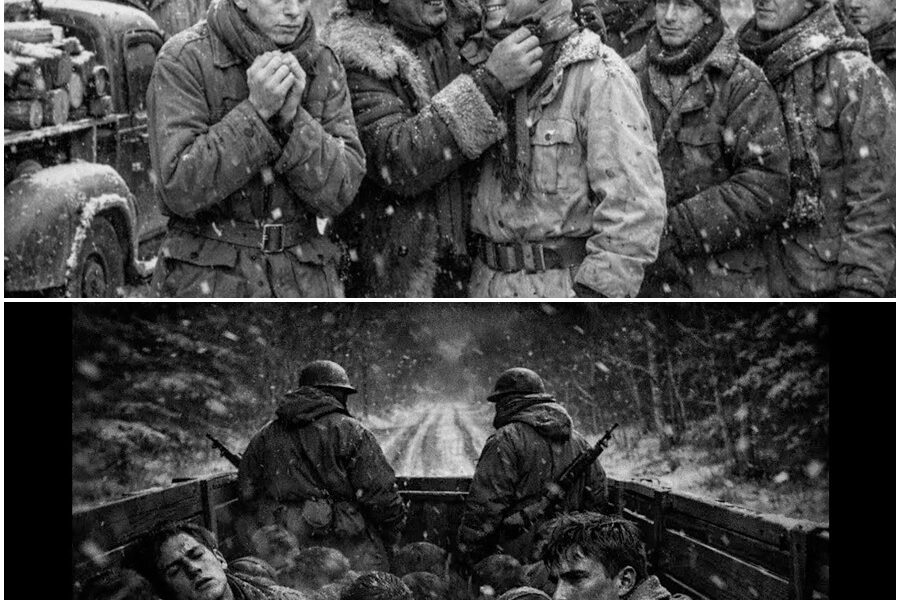
By December, temperatures plunged.
In some camps, frost formed on the inside of barrack walls overnight. Breath lingered in the air like smoke. Blankets were thin, and though rations met official standards, the calories barely matched the energy expended in labor.
Many prisoners had been captured after months of fighting in Europe. They arrived already thin.
Letters home—when permitted—hinted at the cold without directly complaining. Pride restrained many from admitting vulnerability.
Inside the camps, morale dipped.
Rumors spread: This winter will break us.
Yet outside the wire fences, local communities were watching.
And listening.
An Unexpected Gesture
The first sign of change came not from government orders, but from a farmhouse kitchen.
In a small Midwestern town—one of many whose names rarely appear in history books—a farmer’s wife noticed something while overseeing a group of prisoners assigned to help with firewood stacking.
One of the young men struggled to grip the axe. His gloves were threadbare. His coat hung loosely on his frame.
She said nothing at the time.
But the next morning, when the work detail returned, a box sat near the woodpile.
Inside were knitted scarves, spare wool socks, and mittens her children had outgrown.
No speech accompanied the gesture.
No grand announcement.
Just a nod.
The guards hesitated, then allowed distribution.
Word spread quickly—among prisoners and townspeople alike.
From Charity to Solidarity
What began as small, individual acts gradually became coordinated efforts.
Church groups organized clothing drives. Farmers shared surplus produce. A local schoolteacher volunteered to teach basic English phrases during approved recreation hours.
In some towns, families invited small groups of prisoners to holiday meals under supervision. Regulations required oversight, but the warmth inside those dining rooms contrasted sharply with the icy fields outside.
Family games
One former prisoner later recalled his first American Christmas:
“We expected to sit in the barracks and count the hours. Instead, we were given hot cider and listened to carols. It felt unreal.”
For local families, the decision was not always easy. Many had sons or brothers fighting overseas. Emotions were complex. Grief and generosity existed side by side.
Yet something about the proximity—the realization that these were young men far from home, cold and uncertain—shifted perspectives.
Helping them did not erase loyalty to American troops.
It affirmed shared humanity.
Conversations Across Barriers
As weeks passed, interactions deepened.
Farmers began asking about life in Germany before the war. Prisoners asked about American schools, music, and farming techniques.
Language barriers dissolved slowly.
A prisoner who had once studied engineering sketched improvements to a broken irrigation system. Another, formerly a baker, shared bread recipes that local women experimented with in their kitchens.
Laughter, once unimaginable, echoed occasionally across snowy fields.
Not everyone approved.
Some towns debated the appropriateness of such kindness. Newspaper editorials occasionally questioned whether comfort for prisoners might appear insensitive.
But camp commanders noted something practical: morale improved. Discipline issues decreased. Work efficiency increased.
Human connection, it turned out, was stabilizing.
The Farmer Who Took a Risk
One story stands out among many.
In a rural county in the Northeast, a dairy farmer faced losing his herd due to labor shortages. Two of his sons were serving overseas. He applied for prisoner labor assistance.
Among those assigned to him was a former university student named Karl.
Karl had never worked on a farm before. The first week was chaotic—spilled milk, confused cows, shouted instructions in broken English and German.
But winter storms demanded cooperation.
One night, a blizzard knocked out power. Temperatures dropped dangerously. The farmer and Karl worked side by side for hours, hauling feed manually, keeping the animals warm.
Exhausted, they collapsed in the barn’s hayloft.
In that shared exhaustion, something shifted.
The farmer later told his daughter, “He’s someone’s boy too.”
By spring, Karl was entrusted with morning milking routines. When the war ended and repatriation began, the farewell between them was quiet but heavy with unspoken gratitude.
Decades later, Karl returned to visit that same farm—with his grandchildren.
A Season of Shared Survival
Winter did not become easy.
Snow still piled high against barracks walls. Homesickness lingered. Uncertainty about the war’s outcome weighed on everyone.
But fear of destruction by cold gave way to something else: endurance strengthened by community.
Local doctors volunteered extra checkups. Town seamstresses mended uniforms. A hardware store owner donated coal for additional heating in one camp after particularly harsh weather.
Each act alone seemed small.
Together, they formed a network of support that no one had predicted.
The Psychological Shift
Historians studying prisoner experiences in America often note the contrast between expectation and reality.
Many German soldiers had been told they would face harsh treatment if captured. Instead, they encountered structured camps operating under international conventions, supplemented in some areas by unexpected civilian kindness.
The psychological impact was profound.
Bitterness softened. Preconceptions fractured.
For American communities, direct interaction with former enemies complicated simplified wartime narratives. It humanized the abstract.
A local pastor summarized it in a winter sermon:
“We defend our nation with strength. We defend our values with compassion.”
The Letters That Crossed Oceans
As censorship rules allowed, some prisoners wrote home describing their winter.
They mentioned snow-covered barns and warm kitchens. They described children curious about German accents. They sketched small-town streets lined with wooden houses.
Families in Germany, enduring their own hardships, struggled to reconcile these accounts with expectations of suffering.
Family games
In time, those letters became historical artifacts—evidence of a rarely highlighted dimension of wartime America.
Not Without Complexity
This story is not one of universal harmony.
Tensions existed. Isolated incidents of hostility occurred. Suspicion never fully disappeared.
But what makes the winter remarkable is not perfection—it is possibility.
In a season when fear predicted decline, communities chose engagement.
And that choice altered outcomes.
The Quiet Revolution
No official decree ordered kindness.
No headline announced transformation.
Yet across multiple states, a pattern emerged: civilians stepping beyond minimal obligation, extending gestures that turned survival into solidarity.
It was revolutionary not because it overturned governments, but because it redefined relationships.
Enemies became workers.
Workers became acquaintances.
Acquaintances, in some cases, became lifelong friends.
When Spring Finally Came
As ice melted and fields thawed, the prisoners who had braced for destruction by winter found themselves stronger than expected.
Physically sustained.
Emotionally steadier.
And aware that their understanding of America had changed.
When news of Germany’s surrender reached the camps, reactions were subdued. Celebration among guards and townspeople mingled with uncertainty among prisoners about their return home.
But one fact remained clear: the winter that was supposed to break them had instead revealed unexpected humanity.
After the War
Many prisoners were repatriated in 1946.
Some carried photographs of American farms. Others brought recipes, English dictionaries, or small handmade gifts from families who had hosted them.
Family games
A few would later immigrate legally to the United States, citing their wartime experiences as proof that reconciliation was possible.
In small towns, memories lingered.
Children who had once waved shyly at prisoners grew up recalling those winters not solely for snowstorms, but for lessons in empathy.
Why This Story Matters Now
Large-scale conflicts often dominate historical narratives. Battles, treaties, political leaders—these form the backbone of textbooks.
Yet beneath those sweeping arcs lie quieter transformations.
The winter of German prisoners in America demonstrates that even amid global upheaval, local choices matter.
Farmers sharing mittens.
Families opening doors.
Communities balancing loyalty with compassion.
These acts did not erase the war.
They illuminated values within it.
Redefining Strength
Strength is often portrayed as endurance through hardship alone.
But that winter suggests another definition: strength as the willingness to see humanity in unexpected places.
For the prisoners, accepting help required humility.
For the townspeople, offering it required courage.
Together, those qualities turned a season of dread into one of astonishing connection.
The Untold Chapter
Today, historical markers in some towns acknowledge the presence of wartime camps. Museums preserve artifacts—uniform patches, handwritten letters, photographs of snowy fields dotted with barracks.
But many stories remain in family memories.
Stories of shared meals.
Of awkward conversations evolving into laughter.
Of a winter that began with fear and ended with understanding.
Conclusion: The Season That Changed Everything
German prisoners once believed the American winter would be their final adversary.
Instead, it became the backdrop for one of the most quietly powerful chapters of the war.
Not because policies shifted.
Not because headlines proclaimed it.
But because ordinary people—farmers, neighbors, families—chose something unexpected.
Family games
They chose warmth over indifference.
Solidarity over suspicion.
Human connection over inherited hostility.
And in doing so, they transformed a season of isolation into a testament that even in the coldest months of conflict, compassion can endure—and sometimes, astonish the world.