
The Dark Reason Japanese Hated the American M3 “Grease Gun”
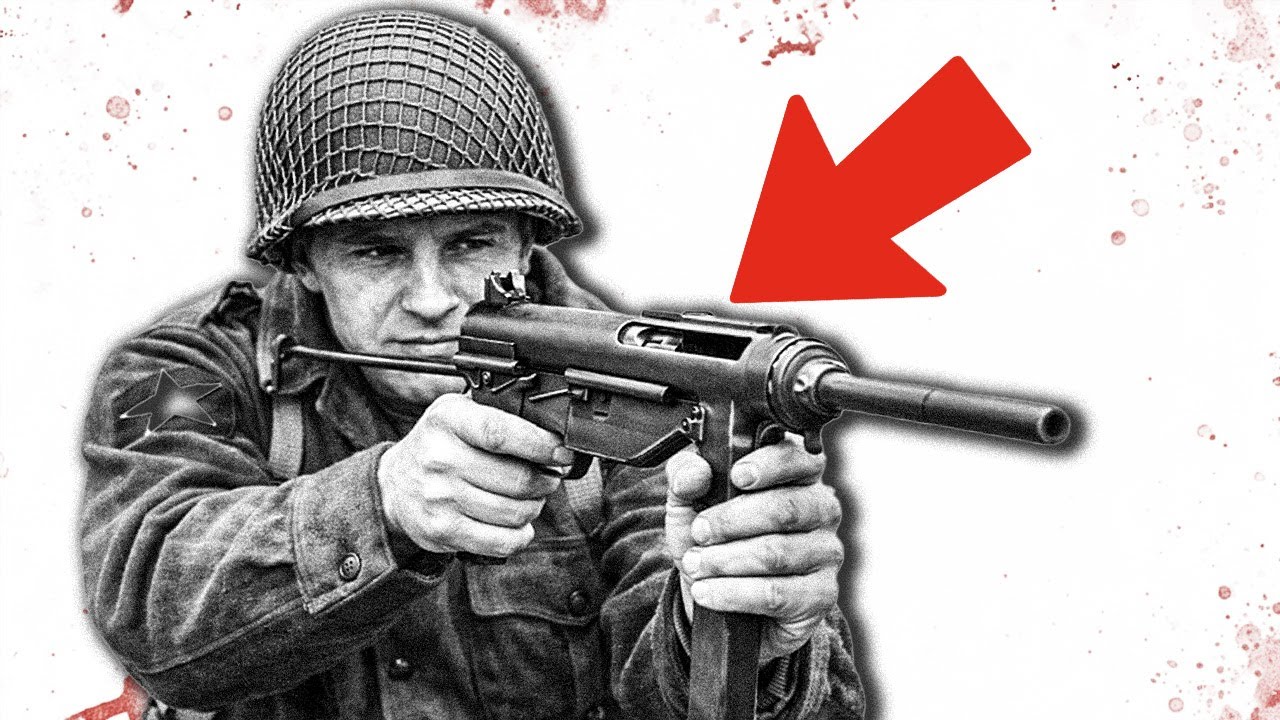
The American M3 submachine gun entered World War II without the visual authority of other famous weapons. It lacked the polished wood of traditional rifles. It lacked the imposing bulk of machine guns. It lacked the iconic profile of the Thompson. Instead, it appeared skeletal, unfinished, and almost improvised.
American soldiers quickly nicknamed it the grease gun, comparing its cylindrical receiver and wires stock to the lubrication tools used in motor pools and factories. This nickname, while humorous, masked the true nature of the weapon. The M3 was not designed to inspire confidence through appearance.
Medal of honor
Discover more
MP40
MP 40
Gangster movie box sets
Artillery fire simulation
Biographical documentaries
Celebrity news digest
Biographical films
News website template
Soldier bravery stories
The Hustler
It was designed to function relentlessly in the most unforgiving forms of combat. World War II increasingly became a war of proximity. While strategic bombing, armored warfare, and naval battles defined the global scale of the conflict, the individual soldier often fought at extremely short distances. Dense vegetation, shattered infrastructure, and fortified defensive systems forced engagements into narrow corridors, enclosed fighting positions, and concealed firing zones.
In these environments, the qualities that mattered most were immediate firepower, mechanical reliability, and ease of use under stress. In the Pacific theater, American forces confronted Japanese troops entrenched in layered defensive systems carved into islands and jungles. Here, the M3 grease gun proved uniquely suited to the task.
The M3 proved particularly challenging for Japanese forces, not because it was technologically advanced or aesthetically impressive. It proved particularly effective because it worked efficiently in situations where traditional combat expectations failed. To understand this reaction, one must examine how the weapon was conceived, how it functioned, and how it altered the dynamics of close-range warfare.
The M3 grease gun was born not from a desire to innovate, but from a need to survive industrial reality. When the United States entered World War II in December 1941, it faced the immense challenge of arming a military that was expanding at an unprecedented rate. Millions of soldiers needed rifles, pistols, and automatic weapons, and they needed them quickly.
The existing submachine gun of the US military, the Thompson, had already proven itself in combat, but it was fundamentally unsuited for mass wartime production. The Thompson submachine gun relied heavily on precision machining and skilled labor. Each unit required extensive time on milling machines and consumed large amounts of highquality steel.
Discover more
MP 40
MP40
Medal of honor
Hollywood News updates
Military history books
Uncategorized news feed
Detective novels
Historical fiction novels
Historical map prints
True crime documentaries
By the early 1940s, its cost exceeded $200 per weapon, an unsustainable figure when multiplied across hundreds of thousands of units. Even worse, its production speed could not keep pace with the rapidly expanding demands of the war. American military planners were forced to rethink their approach. Observing European battlefields, they noted that Germany and Britain had embraced a different philosophy.
Weapons like the MP40 and the Sten were not finely crafted instruments. They were industrial products built from stamped steel, welded components and simplified mechanisms. These weapons could be produced in enormous numbers with minimal machining. And while they lacked refinement, they fulfilled their battlefield role effectively.
In October 1942, the US Army Ordinance Department issued requirements for a new submachine gun that reflected this industrial mindset. The new weapon had to be chambered in 45 ACP to maintain ammunition compatibility. It had to operate reliably in adverse conditions, and most importantly, it had to be cheap and fast to produce.
General Motors Guide Lamp Division, a company deeply experienced in stamped metal automotive components, was selected to manufacture the weapon. This decision alone reveals the philosophy behind the M3. It was not designed by traditional arms craftsmen, but by industrial engineers. The weapon was officially adopted in December 1942 as the M3 submachine gun.
Its design emphasized function over form, and its production reflected America’s ability to transform civilian industry into an engine of war. This industrial efficiency would later become one of the reasons the weapon carried such psychological weight for those who faced it. The effectiveness of the M3 grease gun stem directly from its mechanical simplicity.
Discover more
MP 40
MP40
The Hustler
Hollywood News updates
News content subscription
World War II history books
History-themed board games
Military model kits
News website template
Biographical documentaries
At its core, the weapon used a straight blowback system and fired from an open bolt. This meant that when the weapon was cocked, the bolt remained to the rear until the trigger was pulled. Upon firing, the bolt moved forward, stripped a cartridge from the magazine, chambered it, and fired it instantly. The energy generated by the cartridge, then forced the bolt rearward, ejecting the spent casing, and resetting the cycle.
This design eliminated the need for complex locking systems, rotating bolts, or gas operated mechanisms. Fewer moving parts meant fewer opportunities for failure, particularly in environments filled withdirt, moisture, and debris. The openbolt system also allowed air to circulate through the receiver, helping dissipate heat during sustained fire and reducing the risk of overheating.
The M3’s bolt was intentionally heavy. Its mass slowed the cyclic rate to approximately 450 rounds per minute, which was relatively low compared to other submachine guns of the era. This slower rate made the weapon more controllable during automatic fire. It allowed soldiers to deliver short, effective bursts rather than uncontrollable streams of ammunition.
Medal of honor
In close-range combat, this control translated directly into effectiveness. The receiver itself was made from stamped steel panels welded together, forming a cylindrical housing. This method required far less machining than traditional firearm receivers and could be produced rapidly using industrial presses.
The internal components rode along simple guide rods, and the recoil springs were robust and easy to replace. The weapon fed from a 30 round detachable magazine loaded with 45 ACP ammunition. a cartridge valued for its large diameter and stopping power at short distances. Early production models featured a mechanical cocking handle mounted on the receiver.
While functional, this component proved vulnerable to damage under combat conditions. Soldiers frequently bent or broke it during rough handling. Recognizing this weakness, the Army introduced the M3A1 variant in late 1944. The revised design eliminated the cocking handle entirely, replacing it with a simple finger recess that allowed the bolt to be retracted manually.
This change further simplified production and increased durability. The collapsible wire stock allowed the weapon to be compact and easily carried. This feature was particularly valuable for armored vehicle crews, paratroopers, and infantry operating in confined spaces. The M3 was not designed for long range precision.
It was designed to deliver decisive firepower where space was limited and time was critical. The Pacific Theater presented some of the most extreme combat conditions of World War II. Battles were fought across dense jungles, volcanic islands, coral ridges, and urban ruins. Japanese forces constructed elaborate defensive systems that included camouflaged firing positions, reinforced earthworks, interconnected tunnel networks, and concealed underground strongholds.
These defenses were designed to negate the advantages of American firepower by forcing close engagement. In such environments, traditional infantry tactics were often ineffective. Visibility was limited, movement was restricted, and enemy positions were frequently hidden until contact was made.
Engagements erupted suddenly, leaving little time for careful aiming or coordinated maneuver. Under these circumstances, weapons capable of delivering immediate automatic fire held a decisive advantage. The M3 grease gun was particularly effective in these conditions. Its compact size allowed soldiers to move through narrow jungle trails and confined defensive passages.
Its controllable automatic fire enabled American troops to suppress enemy positions quickly, preventing counterattacks and reducing casualties. The 45 ACP cartridge, while limited in range, delivered devastating effects at the distances typical of jungle and subterranean fighting. Another critical factor was reliability.
The tropical climate of the Pacific was unforgiving to weapons. High humidity caused corrosion while sand and mud clogged finely machined components. The M3’s loose tolerances and simple construction allowed it to continue functioning where more delicate weapons failed. For American soldiers, this reliability built confidence.
For Japanese defenders, it meant facing an enemy whose weapons rarely faltered. The tactical challenges Japanese forces faced toward the M3 grease gun cannot be understood simply as a reaction to another enemy firearm. It was rooted in a fundamental clash between Japanese infantry doctrine and the evolving realities of industrial warfare.
Imperial Japanese Army training emphasized endurance, discipline, and moral superiority. It often prioritized individual resolve and aggressive maneuver over mechanical firepower. Soldiers were taught to close with the enemy, exploit terrain, and rely heavily on bolt-action rifles, grenades, and bayonet tactics.
These methods assumed a battlefield rhythm defined by bursts of movement punctuated by relatively deliberate exchanges of fire. The introduction of compact American automatic weapons like the M3 disrupted this rhythm entirely. The grease gun allowed individual American soldiers to deliver sustained automatic fire without the need for crew support or complex positioning.
Medal of honor
In environments where visibility was limited and engagement distances collapsed to a few meters, the ability to instantly saturate a confined space with heavy caliber rounds proved decisive. Japanese soldiers advancing or defending within dense vegetation,reinforced earthworks, or underground defensive corridors found themselves exposed to sudden, overwhelming firepower that left little opportunity for counteraction.
The 45 ACP cartridge played a crucial role in shaping this perception. While Japanese rifles fired smaller, high velocity rounds designed for longer engagement ranges, the .45 ACP was optimized for short range stopping power. In close combat, particularly within enclosed or semi-encclosed spaces, its large bullet diameter caused severe trauma.
Japanese medical and field reports frequently noted the incapacitating effect of heavy caliber automatic fire which contrasted sharply with the expectations set by rifle combat. The psychological impact of the M3 was further amplified by sound and immediacy. The relatively slow but steady rate of fire produced a distinct auditory presence that echoed through jungle corridors and underground spaces in confined environments.
This sound became disorienting, masking movement and complicating communication. The tactical disadvantage was compounded by what the M3 represented. By the later stages of the war, Japan faced severe shortages of raw materials, fuel, and industrial capacity. In contrast, the M3 embodied American industrial abundance.
It was a weapon designed to be expendable, replaceable, and endlessly reproducible. To Japanese forces increasingly forced to conserve ammunition and equipment, the grease gun represented an enemy that could afford to trade material for lives. A strategic imbalance that fostered deep frustration and bitterness.
Ultimately, Japanese hatred of the M3 was not merely about its lethality. It was about what it revealed. that courage, discipline, and tactical ingenuity could be negated by a weapon designed explicitly to dominate close-range combat through industrial efficiency. The long-term legacy of the M3 Grease gun extends far beyond its service in World War II.
Its continued use in subsequent conflicts demonstrates that its design philosophy was not a wartime anomaly, but a preview of how modern armies would approach infantry weapons in the decades that followed. The M3 remained in American service during the Korean War, where close quarters fighting in urban environments and rugged terrain once again highlighted the value of compact automatic weapons.
Its presence in Vietnam further reinforced its suitability for jungle warfare where reliability and simplicity were paramount. From a historical perspective, the M3 represents a decisive shift away from craftsmanshipdriven weapon design toward industrial optimization. It proved that a firearm did not need to be aesthetically refined or mechanically complex to be effective.
Instead, effectiveness was measured by how easily a weapon could be produced, maintained, and deployed on a massive scale. This principle would later influence the development of post-war submachine guns and assault rifles worldwide. From the Japanese perspective, the M3 occupies a symbolic place in the memory of the Pacific War.
It represents the moment when traditional notions of infantry combat were decisively overshadowed by industrial firepower. For veterans and historians alike, the grease gun stands as a reminder that World War II was not only a clash of ideologies and armies, but a contest between industrial systems. The tactical challenges the M3 grease gun posed to Japanese forces was rooted in experience rather than myth.
It was feared because it functioned relentlessly in environments designed for close combat. It was resented because it neutralized defensive advantages and disrupted established fighting doctrines. Most of all, it was despised because it embodied a form of warfare where survival depended less on courage and more on industrially produced firepower delivered at decisive moments.
The M3 grease gun was never meant to inspire admiration. It was designed to end fights quickly.